Friday, August 12, 2016

THE Curious CASE of Saint Bernard holy shit!!! Its comical!

()
YOU HAVE BEEN WARNED!
DON’T READ if you lack in sense of Humor. 

It’s a work of friction (Humor specifically). Resemblance if any, is coincidental though it has drew inspiration from certain worldly events of the modern living.

The Saint Bernard that usually is a silent dog stands blamed for the shit... the guard on watch found or may be some resident discovered at the basement.

Aftermath followed the vigilance, the informers, the detectives, the investigation …but the most were the acquisitions.

How messy one thinks, can dog excreta be – it questions the sanitation, sanity, sanctity, and security! …almost got comical! A crucial matter.


Prelude:

Admits the Great Derra Valley is the prestigious Stalwarts Welfare Housing. Old folk after years of hard life reside in tranquility. Few have a mini Bar in the veranda and often a well kept spare room for the guest. Most kids have taken their wings. Life at a certain stage can be so lonely, the society is a solace.

The slum that mushroomed along the society wall is not a pretty view, though young journalist for a leading daily wrote an article on illegal encroachment, but who reads the papers anyway and even the few who do, anything beyond fashion and sports is bore. Local politics had prevailed and the big loudspeakers on the small temple and mosque provide the early morning alarm.

Some pet lovers have fancy dogs, few own cats. The lush green parks are well maintained by the society displays the notice 'Pets and dogs not allowed' however stray dogs in the premises enjoy the privilege to roam around with impunity, Tails up! 

The only Saint Bernard living in one of the apartments loves the park, but a few times he was having fun, raised objections.

Most pets out of the house, are just for defecation. The pet lovers walk the proud dogs out of the gates for the morning rituals, some evening too. They are trained and know the routine, well cared! Nobody minds defecation once outside the gates, the slums tolerate it, just waiting to secure their right for existence. Few shops selling tea and daily needs get some business too, from the dog walkers.

Street dogs however detest their privileged breeds, tales down. A pack of hounds that would bark, claiming territory. Few urchins that populated the road look up the stroller's with amusement. They like to watch the good breed of dogs and women.


Prologue:   

Basement is a lonely usually vacant parking lot as hardly anyone parks there. A few months ago it was full of builders crap. Now a few owners have wooden boxes staved in their parking slot but usually it’s well lit and clean.

Earlier the tenant students caused quite a ruckus. Many apartments had overnight transformed into hostel rooms to provide for the students who liked to stay without having to bother of the irksome hostel food and rules while enjoying the freedom of drinking, loitering and mingling with other lovely students, many from the North West. 

Society later formulated a set of hostel like rules . A housing society with hostel restrictions, that at times would irk the few tenant families.

This went to a lot of debate, even over mails if students were any good for a tranquil society, except that it paid for non residing owners’ society maintenance bills and home loans. The students were the rowdies to blame for all nuisance - loud music, intimacy in public and apartments even, over speeding, littering, loitering, quarrels, fights, stealing, trafficking and drugs. 

Finally the students are banned and it’s now supposed, the calm return within and around …until of course came up the matter of the lone Saint B defecate the basement. Such an annoyance as if dogs’ barking was not complaint enough! A storm brewed in the calm morning nice cup of coffee.


The security vouched for not having seen much the Saint B strolling out of the gates to meet the natures call. Probably there is a log maintained. You don’t call a security efficient otherwise.

Sain't B was seen in the park and someone even complained in writing of watching the dog crawling down the basement (or …may be wiggling up). Might even be the owner itself is directing the Saint B there. 

That’s it, guilt established! 

Court proceeding, call kangaroo's!


Finale:

Ignoring a customary formal letter of displeasure a warning in letter issued from the society office duly signed. Scanned copy was received by the owner on email with wonder; numerous emails to the society on various concerns never met any response. Now there is a mail, whatever concerns!


To begin with, it was comical, headline for instance – Use of basement for defecation by dog. (How can defecation by dog be a use of basement?) obviously someone missed to use the Mis(use).


Not to bother your time with silly details... to conclude it stated: Kindly warn your tenants to refrain from such activities (…owner is responsible for his dog, but the owner is not the dog) otherwise the society will be constrained to ask you to get the house vacated immediately (since when anywhere has a dog poo been a cause of eviction).

What it missed was to enclose the copy of received complaint in writing from one of the member whosoever happened to be the witness and evidence submitted to establish it beyond any benefit of doubt to the dog owner.


Moreover the land(flat)lord response and concerns to the email, as usual met a response. Oh No, that would be unusual!

The tenant doesn’t concur to the charges and moreover states to the owners disgust that the Saint B defecates inhouse, (As if one thing is not bad enough, there is something worse) but adds that cleanness is maintained and there also is a maid to take care. Sigh!

Then the backfire – Guards are blocking the way and harassing the dog master on the matter of dog (you know what …sounds disgusting though!), to make it worse the secretary, signatory to the letter won’t listen, instead misbehave in public to make a high decibel show (off …what a jubilant act, almost impressing the guards). Some people wear the scowl of someone who has tasted sour milk and like to yell. After all, why make sense when it is easier to shout over anyone like a demented headmaster. the scowl of someone who has tasted sour milk and like to yell. After all, why make sense when it is easier to shout over anyone like a demented headmaster.

The matter is put up on social forums. People likely have better concerns, the few responses raised further allegations that the next person is a lie…. Only if dogs could talk, probably would be less barking!


Basements are damn isolated spots. Dogs prefer isolation as humans is doubtful, probably they don’t even care! Yet fight over dogs indecent behavior achieve higher levels (oh…maybe lower). Dog fight may not involve just dog!

Glad! Someone kept a watch, only if he would have, in nick of time confronted or even pointed out the dog master and would have shorted it out without prejudice. But that would have taken out all the fun! Open and shut case. Where’s the drama?

Moreover there had been talks of eviction of stray dogs within the compound since …forever! The strays roam in open, every morning one would find the dustbins ram shacked and strays to blame and those in rains shelter in basements. 

Somehow rarely strays defecating issues came up, probably they don’t have owners to blame although residents throwing food waste enough to feed. Any warnings issued? Isn’t it serious? Doesn’t it matter the sanitation? Oh! We are choosy in the issues we pick and what we chose to ignore. There has to be fun. A game: cat and mouse preferably!


Epilogue:

Some owners won’t still let go the students while others are hoping to find family tenants. As a young property dealer commented, ‘’Landlords are abundant, it’s the tenant who is the God, don’t annoy it, if ever you find one”. The dealer perhaps never studied, while one studies long and hard, secures a job and again works long and hard to be a landlord (though it may just be a flat), only to hear a jobless 20 something say so. 

One owner even posted on a rowdy lady he had as a tenant who won’t pay the rent and damaged the apartment. Complaints never get over or one may never get over complaining. It’s our circumstances or just us! 


There are further issues of Bachelor apartments, over drunkenness, apartments serving as company guest houses and other commercial services within apartments.

New upcoming society with severe construction quality issues, usual with most constructions nowadays, is passé matter. Affluent society’s deals are.... serious, such as pet dogs. Poor societies are concerned on maintenance, water, electrithefuckcity and survival, so down class!


The commotion brought up the matter of CCTV surveillance at access points and secluded spots. The guards too are vigilant. Wonder why dog stands for safety!

It's been about dog though, letter from residents welfare society, displays its concern of serious matters…. So serious!


The local paper devoted it's Sunday editorial space to the notorious pet dogs with a picture of saint B. The dog looked cute, the society kids loved it and that miffed the society. Bags full of free adoption request pour in daily. The post office had to hire an auto for delivery. Invitation are being sought for a television channel prime time debate on pets (Gus's why it's called the idiot box, though no more a box). A round of applause please, the show just begun!


PS: Comments are free and welcome, pour in!

Be human and let the dog be the dog! Stay cheerful and blessed.  


Sunday, January 19, 2014

Baud Rate (...don’t miss the Rate!)

          The measure was named after a French engineer, Jean-Maurice-Emile Baudot, the inventor of the asynchronous telegraph printer.  It was first used to measure the speed of telegraph transmissions, and is represented in accordance with the rules for SI units
.

          Baud unit symbol "Bd is synonymous to symbols per second or pulses per second. It is the unit of symbol rate, also known as baud or modulation rate; the number of distinct symbol changes (signaling events) made to the transmission medium per second in a digitally modulated signal or a line code.


          Baud is related to but should not be confused with gross bit rate expressed in bit/s. A baud is a unit of measure for analog signaling. At a minimum, one baud corresponds to one bit per second (bps) although at higher signaling speeds, multiple bits can be transferred in a single baud.


          Baud was the prevalent measure for data transmission speed until replaced by a more accurate term, bps (bits per second). One baud is one electronic state change per second. Since a single state change can involve more than a single bit of data, the term characters per second (CPS) is closer than the term bps (bits per second).


          The confusion between bps and baud started back when antique low speed modems were high speed modems, the bps rate actually did equal the baud rate. One bit would be encoded per phase change. People would use bps and baud interchangeably, because they were the same number.


           For example, a 300 bps modem also had a baud rate of 300. This all changed when faster modems came around, and the bit rate exceeded the baud rate.


          One way this problem gets resolved is to use the term "symbol rate" instead of "baud" and thus avoid using the term "baud". However, when talking about the "speeds" between the modem and the serial port (DTE speed) baud and the symbol rate are the same. And even "speed" is a misnomer since we really mean flow rate.


          Currently though bps unit of measurement has replaced it as a better expression of data transmission speeds.


          A simple example to clear any ambiguity:


           A baud of 1 kBd = 1,000 Bd is synonymous to a symbol rate of 1,000 symbols per second. In case of a modem, this corresponds to 1,000 tones per second, and in case of a line code, this corresponds to 1,000 pulses per second. The symbol duration time is 1/1,000 second = 1 millisecond.


          In digital systems (i.e., using discrete/discontinuous values) with binary code, 1 Bd = 1 bit/s. By contrast, non-digital (or analog) systems use a continuous range of values to represent information and in these systems the exact informational size of 1 Bd varies.


           In simple digital communication links use only one bit per symbol, such that binary "0" is represented by one symbol and binary “1 by another symbol. However, in advanced modems and data transmission techniques, a symbol may have more than two states, so it may represent more than one bit (a binary bit always represents one of exactly two states).


          At slow speeds, only one bit of information (signaling element) is encoded in each electrical change. The baud, therefore, indicates the number of bits per second that are transmitted. For example, 300 baud means that 300 bits are transmitted each second (abbreviated 300 bps).


          Assuming asynchronous communication, which requires 10 bits per character, this translates to 30 characters per second (cps). For slow rates (below 1,200 baud), you can divide the baud by 10 to see how many characters per second are sent.
At higher speeds, it is possible to encode more than one bit in each electrical change. 4,800 baud may allow 9,600 bits to be sent each second. At high data transfer speeds, therefore, data transmission rates are usually expressed in bits per second (bps) rather than baud. For example, a 9,600 bps modem may operate at only 2,400 baud.


          With relevance to data serial cables used in Hydrographic surveys, the baud rate is significant to compensate for large data strings, data requiring high updates or high resolution.


          Note the change of bite frame length in relation with time at a baud rate 4800 is 10 bits in 2.083 ms and at 19200 it is 0.560 ms. To me this signifies two things; high baud rate allows for a bigger data string to be processed & for a shorter data string it allows  higher update (…better resolution).


If you didn’t get it still… read on!


          bps is simply the number of bits transmitted per second. The baud rate is a measure of how many times per second a signal changes (or could change). For a typical serial port a 1-bit is -12 volts and a 0-bit is +12 v (volts).


          If the bps is 38,400 a sequence of 010101... would also be 38,400 baud since the voltage shifts back and forth from positive to negative to positive, etc. and there are 38,400 shifts per second. For another sequence say 111000111... there will be fewer shifts of voltage since for three 1's in sequence the voltage just stays at -12 volts yet we say that it’s still 38,400 baud since there is a possibility that the number of changes per second will be that high.


          Looked at another way, put an imaginary tic mark separating each bit (even though the voltage may not change). 38,400 baud then means 38,400 tic marks per second. The tic marks at the instants of permitted change and are actually marked by a synchronized clock signal generated in the hardware but not sent over the external cable.


          Suppose that a "change" may have more than the two possible outcomes of the previous example (of +- 12 v). Suppose it has 4 possible outcomes, each represented by a unique voltage level. Each level may represent a pair of bits (such as 01). For example, -12v could be 00, -6v 01, +6v 10 and +12v 11. Here the bit rate is double the baud rate.


          For example, 3000 changes per second will generate 2 bits for each change resulting in 6000 bits per second (bps). In other words 3000 baud results in 6000 bps.


          The above mentioned example is overly simple. Real examples are somewhat complicated but based on the same idea. This explains how a modem running at 2400 baud, can send 14400 bps (or higher). The modem achieves a bps rate greater than baud rate by encoding many bits in each signal change (or transition). Thus, when 2 or more bits are encoded per baud, the bps rate exceeds the baud rate.


          I leave it to your discretion while I conclude my discussion. Hope it was of some aid.


Cheers!!!


PPS (Pulse Per Second) …simple as that!


          Scholarship hypothetically makes men wiser, many times though it gets one stubborn…. Don’t get perplexed! With all the intricacy involved, the rudiments are straightforward.


          The concept of PPS originated with the man’s quest in space. The atomic clocks orbiting around the earth in GPS satellites are utilized to obtain accurate timing. Today PPS is found in applications requiring synchronization such as cellular networks, telecommunications timing, digital TV and radio transmission, calibration laboratory systems, internet, stock market, computer games and precision stuff like surveys where various data have to correspond in respect to time.


          The atomic clocks in the GPS satellites are monitored and compared to 'master clocks' by the GPS Operational Control Segment; this 'GPS time' is steered to within one microsecond of Universal Time. GPS receivers provide 1PPS output signal. This pulse normally has a rising edge aligned with the GPS second, and is used to discipline local clocks to maintain synchronization with Universal Time (UT).


          Time is crucial in hydrographic multi beam survey because each piece of data received from a device is immediately stored in the raw data files, in order to correlate it with data coming from other devices, i.e. motion sensors, heading, position and sound velocity, we need to stamp the time the measurement was taken.


          This note is in particular relevance with offshore hydrographic survey….but in general, it will be good in all relevant contexts.


          While totally rigorous testing of timing pulses requires an atomic clock reference, useful information can be gathered using a survey-grade, dual-frequency GPS receiver as the timing reference.


          There is a time difference (offset) in different GPS receivers. The standard deviation of this offset provides a measure of the pulse stability or 'jitter'. There are two factors to be considered in judging performance, one is the average offset time and the other is the standard deviation of the offset as an indicator of jitter. However, once the average offset is known, it can be compensated for. Timing compensation can be made in some receivers.

         
          The 1 pps output doesn't come directly from a satellite. It comes from the receivers own internal clock. That clock is synchronized with the satellites. The 1 pps output doesn't go away if the receiver looses reception (…it just gets less accurate).


          A gps device sends various strings with UTC time information in many of the strings (Time values in Universal Time Coordinated (UTC) are presented in hhmmss.ss format, where hh is hours (00–23), mm is minutes, and ss.ss is seconds and fractions of seconds.).… For time stamping though, NMEA ZDA string which sends timestamps along with day, month &year, local zone number and local zone minutes is most pertinent.


          The ZDA message structure is:

$GPZDA,184830.15,05,11,1996,00,00*66

          NMEA messages begins with a dollar sign ($) followed by a talker ID code (for example GP) and a message ID code (for example, ZDA). It ends with a carriage return and line feed.


To my knowledge, these devices use a specific trigger point on when they send the sentence with the .000 timestamp.


          May a NMEA string confuse you with Null fields?  Null (empty) fields are included if no data is available. These fields are usually reserved for data that is transmitted on a periodic or irregular basis.


          Note that because the PPS signal does not specify the time, but merely the start of a second, one must combine the PPS functionality with another time source that provides the full date and time in order to ascertain the time both accurately and precisely. So now I parse the ZDA sentence, and take the timestamp when the $ is received. I compensate for any further characters being read in the same operation using a high serial port baud rate.

          Note the change of bite frame length in relation with time at a baud rate 4800 is 10 bits in 2.083 ms and at 19200 it is 0.560 ms. To me this signifies two things; high baud rate allows for a bigger data string to be processed & for a shorter data string it allows  higher update (…better resolution).

          From this information (TTL Pulse with NMEA ZDA) the system driver calculate the offset for correcting the system time, it compares, the time set on the processing system or the computer, i.e. if I get a constant difference of 250ms – this when corrected manually after the latency calibration, I'm within a deviation of 20- 30 ms, which is ok for my multibeam application.

          We have to take into account a few things that are going on in GPS device:
·         Receive satellite signal and calculates position, velocity and time.
·         prepare NMEA message and put it into serial port buffer
·         transmit message

          GPS devices have relatively slow CPUs (compared to modern computers), so this latency we are observing is result of processing the device must do between generation of position and moment it begin transmitting data.

          Here is one examples of latency in GPS receivers. There you can find measurement of latency for specific NMEA sentences.


Time Tag accuracy falling beyond 400 ms error…


Time tag – Pulse matching
          In this case there is system latency, as Time tag arrival and time tag accuracy are just the same, however beyond a certain point of time the accuracy gets beyond the time synchronization software acceptance limit.


          Through the options you can guide the synchronization software on time tagging.


          The great majority of devices does not give (…or use computer or the processor) time of the measurement as part of the data string so we are forced to assume that the arrival time of the message is the actual time of the measurement.


          To compensate for the difference between the arrival time of the data (that we use as our time-tag) and the real time of the measurement, we can subtract a ”latency” time which is exactly that: the time interval between the measurement and the arrival of the data string with that measurement.


          Let's take an simple example of a GPS receiver: On the integer second, the receiver measures the signal propagation time from each of the satellites and starts calculating its position. After solving the many equations involved and feeding the results through some filters (Kalman and other filters), it finally generates a position value that is sent out through a NMEA GGA message.


          By the time we receive the GGA string, the boat has moved from where it was at the integer second and the depth values coming from the echosounder are also quite different.

          The timeline would be:

Computer time   GPS time            Obesrvation
12:30:50.01 :                                            : 10.3m
12:30:50.11 :                                            : 10.5m
12:30:50.21 :                                            : 10.7m
12:30:50.31 :                                            : 10.8m
12:30:50.40 :      12:30:40.40      $GPGGA,123040.0,1213.1415,N,7020.567,W,....
12:30:50.41 :                                            : 10.9m

If you didn’t notice, keep reading…

          In this case the GPS has a latency of 10 ms compared to the computer time. Thereby the computer took 10 ms to compute and send the data to QINSy.  By the time the GPS sent the data to QINSy, the echosounder depth had changed to 10.3 to 10.9.


          This is a simplification as QINSy does not assign depth values to positions; instead it assigns positions to depth values, but the effect is the same for our purposes.


          The GPS position string contains the time of validity of the position (12:30:40.0), but we cannot use it because the computer clock is not synchronized to the GPS clock. Data coming from the echosounder does not contain any timing information so we must continue to use the computer clock for it and we can only hope that we get little latency.


          If we knew that the GPS latency is 0.4 seconds we could just subtract this latency from the arrival time of the GGA message and everything would be fixed.


          Latency is the time from when a piece of equipment computes a value until it is actually transmitted to your computer. This was most evident in older GPS receivers, but as technology improves we see smaller latency values. Improvements in the offset standard deviation are observed when operating the GPS receivers in time-only solution mode.


          The simplest method to determine the latency is to run the latency calibration test. Run the same line over a sloping bottom in opposite directions and process the two data files to the calibration software. The software if set to ‘auto’ mode, goes through the data files, adds a latency value, recalculates sounding positions with that latency value, then calculates the depth differences at each point between the two files. It then changes the latency value and repeats the whole process.


          With a bit of luck, we may end up with a U-shaped curve of average depth differences and the bottom of the curve indicates the best fit between the two profiles. That is the latency value indicated by the calibration LATENCY software.


          The resulting latency is, not only the latency of the GPS but more of a global system latency involving the GPS, computer and echo sounder. All gets combined in the calculated latency value, but we choose to call it GPS latency because, traditionally, the GPS is responsible for most of it. Once a latency value is determined it can be entered into the Multi beam hardware configuration (as GPS latency) and that value will be subtracted from all time tags for that device.

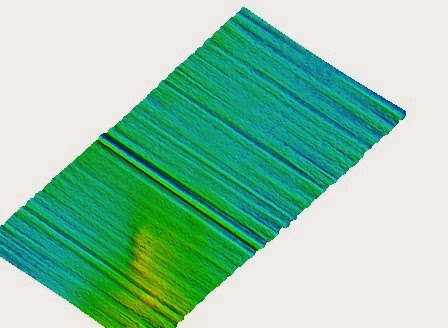
Offshore Argentina Multi beam processed survey data with latency issues.


          As opposed to all other corrections, the latency value is subtracted from the time tags. This is one of the rare cases where we write “corrected” values in raw data files.

Offshore Argentina Multi beam processed survey data with resolved latency issues.


          Even after correcting data for latency we need time synchronization as there are errors affecting the calculated latency value:

• Not running the two lines exactly one on top of the other
• Changes in depth correction factors (tide, draft, sound velocity)
• Jumps in position due to poor GPS positioning or reflections (bridges, piers, vessels, etc.)
• GPS position quality, offsets, survey conditions, offline distance and even computer ports can influence the latency. (…preferably use Com 1 &do not use USB to serial adapters!!).

         
          Don’t base your latency value on one test! Run as many lines as possible and take an average. Run your lines as close to the planned line as you can and scrutinize those graphs and profiles!


          Also, the latency value can change depending on factors such as the number of satellites.


          Therefore we try to synchronize the computer clock with the GPS clock and take advantage of the time of applicability contained in the GPS messages. If we can synchronize the two clocks, we can use the time tags provided by the GPS receiver for data coming from it and the synchronized computer clock for data coming from other devices like the echo sounder. For this purpose as mentioned earlier NMEA ZDA message that seems almost perfect for this purpose as it contains just the GPS time and date.


          How it all evolved:

          Years ago we used a fairly naive approach to synchronization where we would take the ZDA message and set the computer clock to the time indicated in that message. The problem with this approach is that the two clocks can (and will) drift in time and, unfortunately, you cannot redo the synchronization in the middle of logging a data file because it would wreak havoc with all the time tags.


          This is a software loop (In electronics terms call it a PLL {Phase Lock Loop}) that constantly monitors the difference between the GPS clock and the computer clock and slowly changes the computer clock to match the GPS clock. This basically was a time management model. If you turn on synchronization and you run the latency test you should obtain latency very close to 0.


          The latency is not always Zero when using synchronization.     Sometimes the resulting latency is still quite appreciable and this has to do with how the ZDA message is sent.


          In the NMEA standard there is no, specification that the ZDA message should be exactly on the integer second or about the accuracy of the time indicated in the message. If we look at a typical ZDA message:

$GPZDA,163448.014,09,03,2011,00,00*57


          We see that the GPS unit bothered to output the time to milliseconds resolution so we can hope that it started to send the ZDA message at that exact moment. This is however not the norm for all GPS receivers. Other receivers could send the same message as:

$GPZDA,163448,09,03,2011,00,00

(Without any milliseconds) and send it somewhere during that second but without paying much attention to its timing.


          If the GPS sends ZDA messages more often than once per second there is a complete mayhem! Veritime will jump off its rails and very soon you will see the dreaded “SYNC FAIL” error in the Pulse synchronization program. For fans of electronics, each PLL loop has a certain bandwidth and sending ZDA messages more often than once per second falls outside the Veritime bandwidth.


          In case the ZDA messages are sent less than one per second (once every 2 or 5 seconds). It will work, without doing any good, because the time management model will adjust the clock model only when it receives a ZDA message, we are allowing the two clocks to drift apart for a longer interval.


          The pulse per second output from the GPS receiver. This is an electrical pulse that we bring through a small level converter to a RS-232 pin (the CTS signal) and use it as reference to our PLL loop instead of the ZDA message. To use the PPS pulse we need a “PPS box” that does the electrical adaptation of the GPS signal to the RS-232 levels.

         
          The ZDA message is still needed because we need to know the clock reading when the PPS pulse occurred. This is the most accurate method one can currently use to synchronize the GPS and computer clock.


          As a rule of thumb: the latency errors we can expect are:

• Latency test software: 50 to 100ms but can change unexpectedly.
• ZDA message for time sync: 20-30 ms; good enough for singlebeam.
• PPS signal for time sync: 1-5 ms; good for  multibeam.


          To check synchronization or compare the PPS pulse to the ZDA message, the “ZDA time plot” program that shows a graph of the synchronization error between the GPS clock and the computer clock.


          In case the synchronization doesn’t work on the computer, take heart in knowing that you aren’t the only one, it’s the possibly the hardware.

Suggested workarounds:

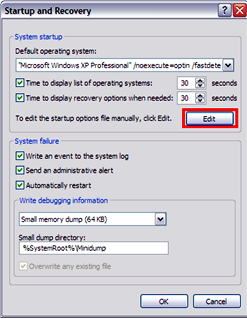
 Windows XP systems.

Open the System properties dialog box (Control Panel -> System) and select the “Advanced” tab and under ‘Start up and Recovery’, click [Settings].
           
 Add the string “/useptimer” at the end of the line with the operating system.
Save the file and reboot your system.

Windows 7

Disable “Intel SpeedSetp Technology” in your BIOS settings.


Go ahead investigating and do keep me posted...


          In Multibeam systems, where these echosounders are also fed the PPS pulse from the GPS, it sends UTC time-tagged data output, QINSy time tags the other system inputs. Similar options for time tagging are available in the POS/MV.


          We are coming to a phase where all systems will be time tagging their data and be getting synchronized; thereby latency concerns will be reduced (if not removed). 

So we are good!!! Gracious amigos!


Followers